For decades, women have been given a fairly simple message when it comes to exercise: if you want to lose weight, stay slim and get fit, do more cardio.
Run. Cycle. Get on the cross trainer. Burn more calories. Sweat more.
Strength training, meanwhile, was often treated as something for bodybuilders — with many women actively avoiding weights because they were worried about becoming “bulky”.
Thankfully, our understanding of women’s health and fitness has moved on.
At Ferocia Health & Fitness, we’re certainly not anti-cardio. Cardiovascular exercise can be fantastic for your heart, fitness, stamina and mental wellbeing.
But cardio doesn’t need to be the main event.
For many women — particularly as we move through our 40s, perimenopause, menopause and beyond — strength training deserves a much bigger place in the picture.
It’s time to stop exercising simply to burn calories
One of the biggest problems with the old-fashioned approach to exercise is that everything became about calories.
How many did you eat? How many did you burn? How long do you need to spend on the treadmill to “work off” dinner?
We’d like to change that conversation.
Exercise can do so much more than make your body smaller.
It can make your body stronger.
Strength training helps us build and preserve muscle, increase physical strength and maintain our ability to perform everyday activities as we get older.
It also provides an important stimulus for our bones — something that becomes particularly relevant for women as oestrogen levels decline around menopause and bone loss can accelerate.
Rather than asking, “How many calories did I burn?”, perhaps we should start asking:
“What am I doing today that will help my body remain strong and capable in ten, twenty or thirty years?”
That’s a very different way of looking at fitness.
But won’t lifting weights make me bulky?
This is probably one of the most persistent myths we hear from women.
The reality is that accidentally developing huge amounts of muscle simply because you started lifting weights a few times a week is highly unlikely.
For most women, regular resistance training is far more likely to create the strong, firm and defined appearance they’re actually hoping to achieve.
And the benefits go far beyond appearance.
Being able to carry your shopping, lift a suitcase, get up from the floor, maintain good balance and continue doing the things you enjoy as you age are all pretty compelling reasons to become stronger.
Muscle isn’t something women should be frightened of building. It’s something worth protecting.
So where does cardio fit?
Cardio absolutely still matters.
Walking, swimming, cycling, jogging, dancing, classes — whatever you genuinely enjoy — can all contribute to cardiovascular health, fitness and general wellbeing.
But cardio doesn’t always have to mean pushing yourself to exhaustion.
Moderate-intensity sessions can sit alongside strength training beautifully. Higher-intensity interval work can also be included where appropriate for the individual.
The important word here is balance.
You don’t need every workout to leave you red-faced, drenched in sweat and completely exhausted for it to have been worthwhile.
And don’t forget recovery
This is another area where attitudes towards fitness are changing.
We used to celebrate the “no days off” mentality.
At Ferocia, we’d rather celebrate listening to your body.
Walking, gentle yoga, Pilates, stretching, mobility work and simply allowing yourself adequate rest can all form part of a successful training programme.
Recovery isn’t being lazy.
Recovery is when your body gets the opportunity to adapt to the training you’ve asked it to do.
And if you’re already juggling work, family, hormonal changes, poor sleep and the general demands of life, continually adding more physical stress isn’t necessarily the answer.
A better approach to women’s fitness
There isn’t one perfect exercise programme that every woman should follow.
Your age, health, experience, lifestyle, goals, preferences and available time all matter.
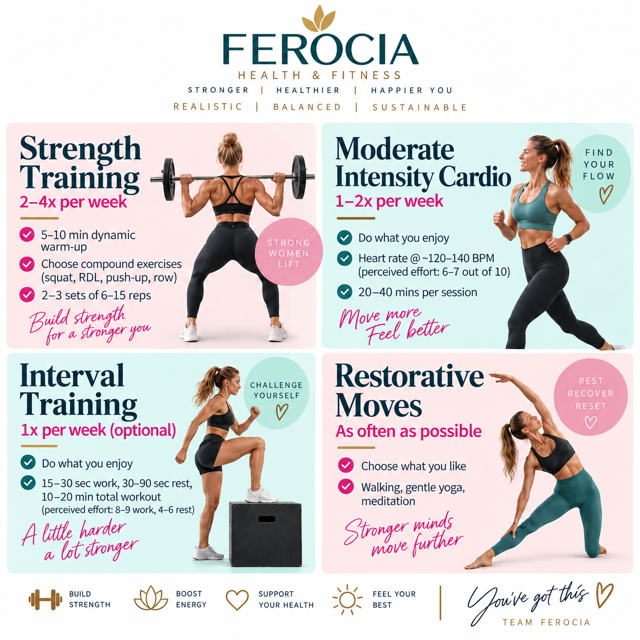
But a balanced week might include a combination of:
Most importantly, choose forms of movement you can realistically maintain.
Because the best training plan isn’t the one that looks the most impressive on paper.
It’s the one that works for your body and your life.
So perhaps it’s finally time to retire the idea that cardio is king.
Don’t exercise simply because you want to burn more.
Train because you want to build more — more strength, more confidence, more resilience and a body capable of carrying you through the years ahead.
Lift. Move. Recover. Repeat.
Stronger. Healthier. Happier you.